Think of end mills as the wrenches or measuring tools on your bench: each one tells you something about the job. When a wrench slips or a caliper gives an off reading, you know there's a reason, and looking closer gives you valuable insights. In the same way, examining your end mills for wear or paying attention to how they cut can reveal insights into the materials, setups, and techniques you use every day.
Coatings are where that logic gets expensive fast. The wrong tool coating can make your problems worse, not better.
That's why this guide exists. At one point, all of us were walking into the shop for the first time. All of us saw our first coated tool and wondered why some tools got paint jobs while others didn't. This is for those who've had their curiosity piqued by the chemistry and nuance of end mill coatings.
This guide is also an ROI tool. Choose the wrong coating for the job, and you're burning money. Don't burn your money. Read on.
Before we dive into any specifics, let's get the basics covered.
A PVD (Physical Vapor Deposition) coating is a thin ceramic layer (usually 2-5 microns thick) applied to the carbide substrate of your end mill.
At this thickness, it doesn't dull your cutting edge or alter your cutter's geometry. It's thin enough to be undetectable by touch, but strong enough to change how your end mill moves through a cut. What changes is how the tool surface interacts with heat, friction, and whatever you're cutting.
Coatings do three things in various combinations:
- They increase surface hardness, which resists abrasive wear at the cutting edge.
- They act as thermal barriers, either insulating the tool from heat or directing heat into the chip.
- They reduce friction during the cut, which limits the conditions that lead to built-up edge and chip-welding issues.
Different coatings prioritize these in different ways, which is what makes the choice crucial and application-specific.
In the next section, we'll take a closer look at some of the most popular end mill coatings you'll see on tools around the machine shop.
TiB2 (Titanium Diboride) - The Standard for Milling Aluminum
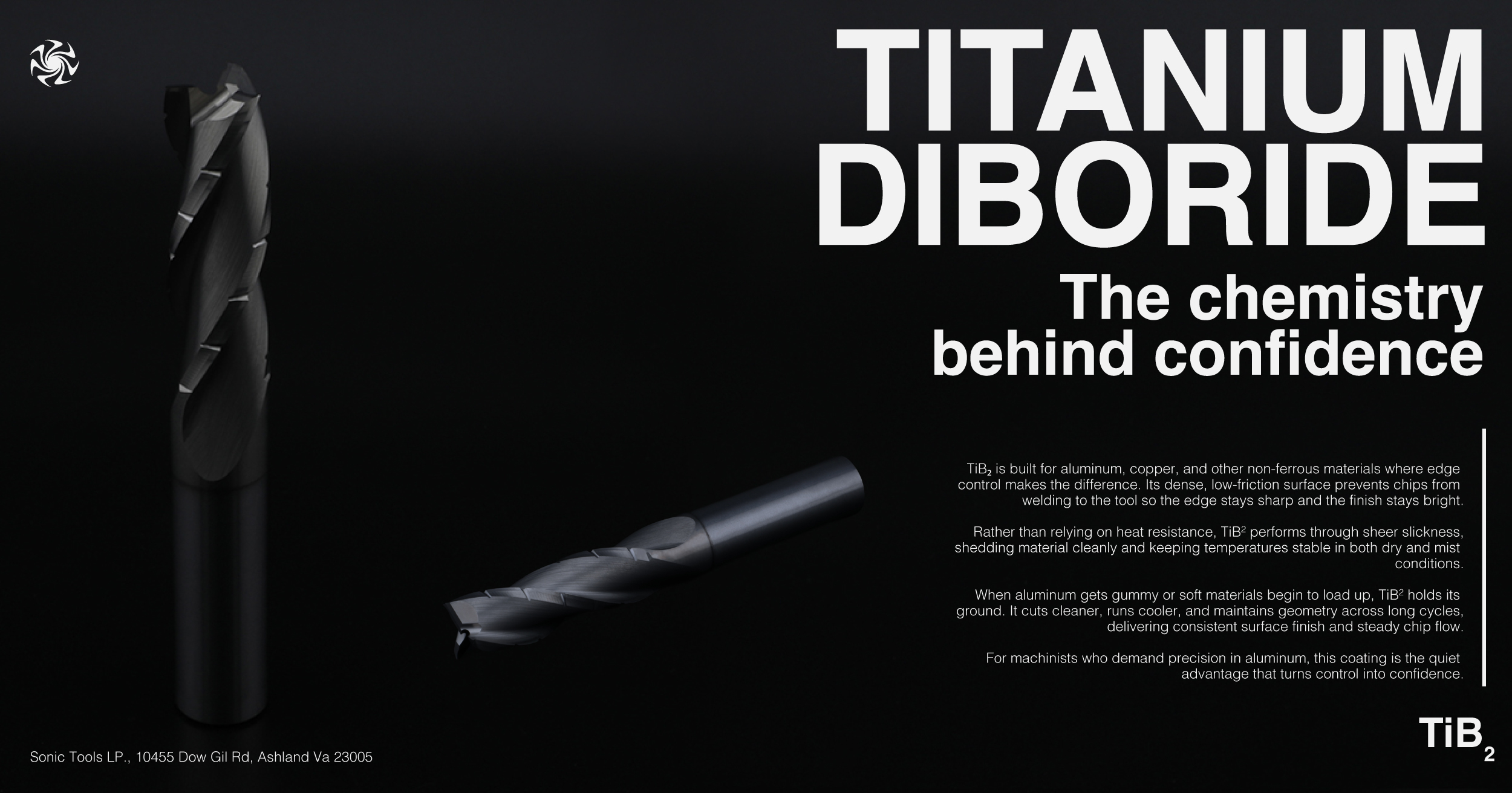
TiB2, or Titanium Diboride, is a coating built specifically for aluminum and other non-ferrous materials.
What makes TiB2 special is its low affinity for aluminum. The coating chemistry resists adhesion, preventing built-up edge at your tool's cutting edge.
It's useful to understand the mechanism at play here. When cutting, TiB2 forms boron oxide tribo-films at the tool-chip interface. These films self-lubricate the contact zone, reducing friction and limiting the conditions under which aluminum bonds to the cutting edge.
The result is cleaner chip separation, less buildup at the edge, and a finish that holds longer into the tool's life.
Quick Specs:
- TiB2 has a maximum working temperature of up to 1,040°C (1,904°F), which is appropriate for aluminum applications where cutting temperatures are comparatively low.
- Its hardness is exceptionally high at approximately 39 GPa (4,000 HV), higher than most nitride coatings.
At Sonic Tools, we use a unique TiB2 coating that improves the tool's maximum operating temperature up to 1,100°C. If you'd like to speak to us about how this can benefit your aluminum applications, we're always available to discuss.
Important to understand:
TiB2 is used for non-abrasive aluminum alloys, such as standard wrought aluminum alloys like 6061. For highly abrasive grades like high-silicon cast aluminum, other coatings, such as diamond or ZrN, may be better equipped to handle the increased abrasive load.
Early warning signs include edge chipping, rapid dulling, and flaky or chipped coating along the tool's cutting edge. Catching these early means you swap the tool before the part tells you to.
For general aluminum milling, including finishing passes, profiling, and pocketing in 6061, a TiB2-coated end mill with a high-helix and polished flute geometry is the right starting point.
It's exactly what Sonic Tools' 200 Series aluminum end mills are built around.
AlTiN (Aluminum Titanium Nitride) - The Ferrous Workhorse
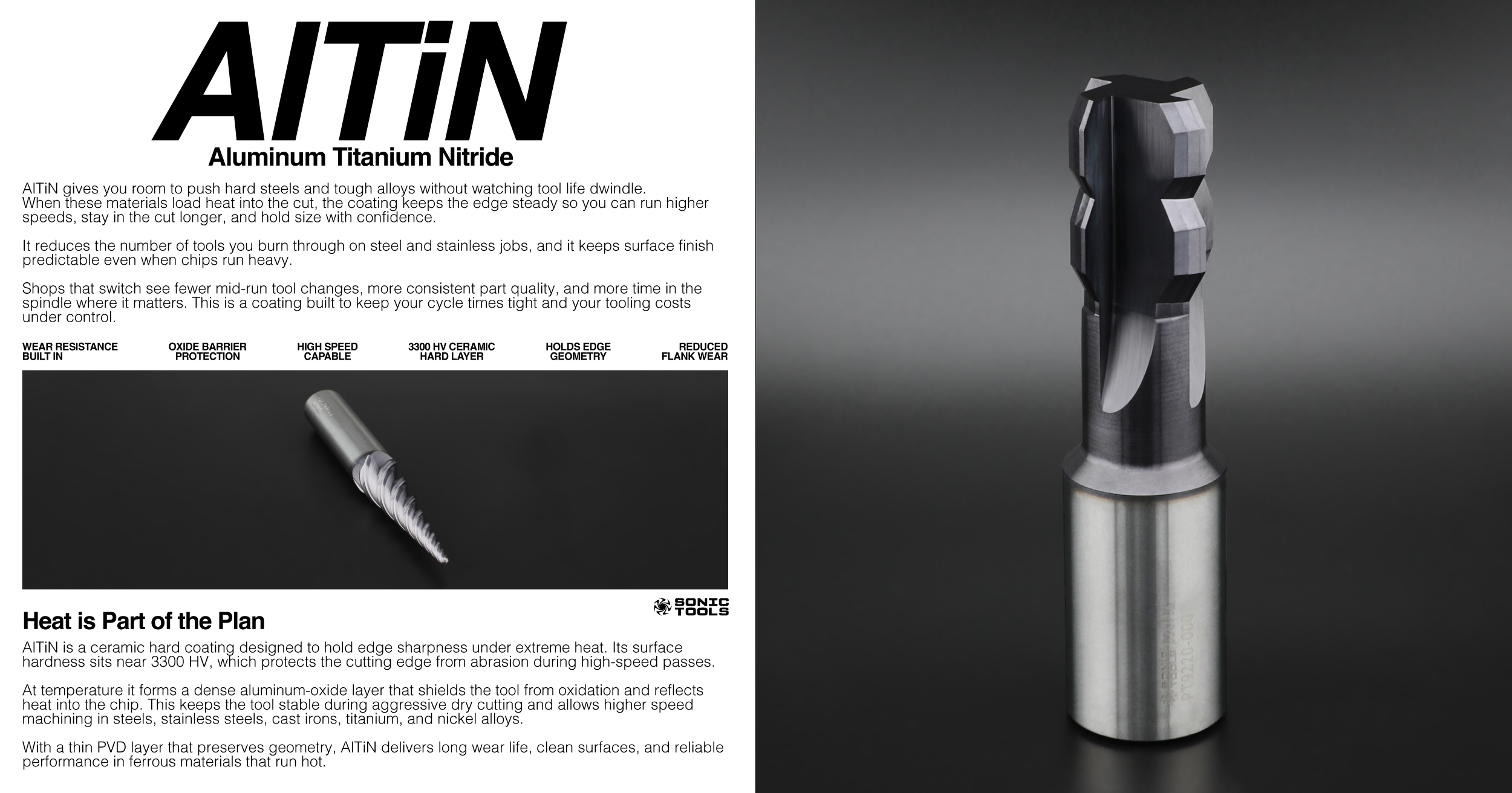
AlTiN, or Aluminum Titanium Nitride, is one of the most common coatings you'll see anywhere near industrial machining, and for good reason. It's hard, heat-resistant, and does the job across a broad range of ferrous materials.
AlTiN's performance comes down to one thermal behavior worth understanding. At elevated cutting temperatures, the aluminum baked into the coating converts to aluminum oxide, which is a hard ceramic compound that forms a thermal barrier on the tool's surface. This self-generating layer insulates the cutting edge from heat and adds hardness under the conditions that would otherwise wear it down.
Think of it like a smartphone's lockdown mode: standard protection until conditions get serious, then an additional layer kicks in automatically. AlTiN works the same way: the hotter it gets, the harder and more protective the coating becomes.
Quick Specs:
- AlTiN's hardness is around 32 GPa (3,300 HV).
- Its maximum working temperature is around 900°C (1,652°F).
- AlTiN is typically between 2 and 5 microns thick, so it doesn't alter geometry or dull the cutting edge.
Important to Understand:
Don't use AlTiN when milling aluminum. The aluminum in the coating has a high chemical affinity for aluminum workpiece material. At cutting temperatures generated during aluminum machining, the coating doesn't form a protective barrier; it reacts with the workpiece.
This misapplication results in chip welding and a built-up edge, and accelerates tool wear. So, instead of being the hero, it turns into the villain. This is most commonly experienced by shops that only utilize 1-2 coatings across a variety of workpiece materials.
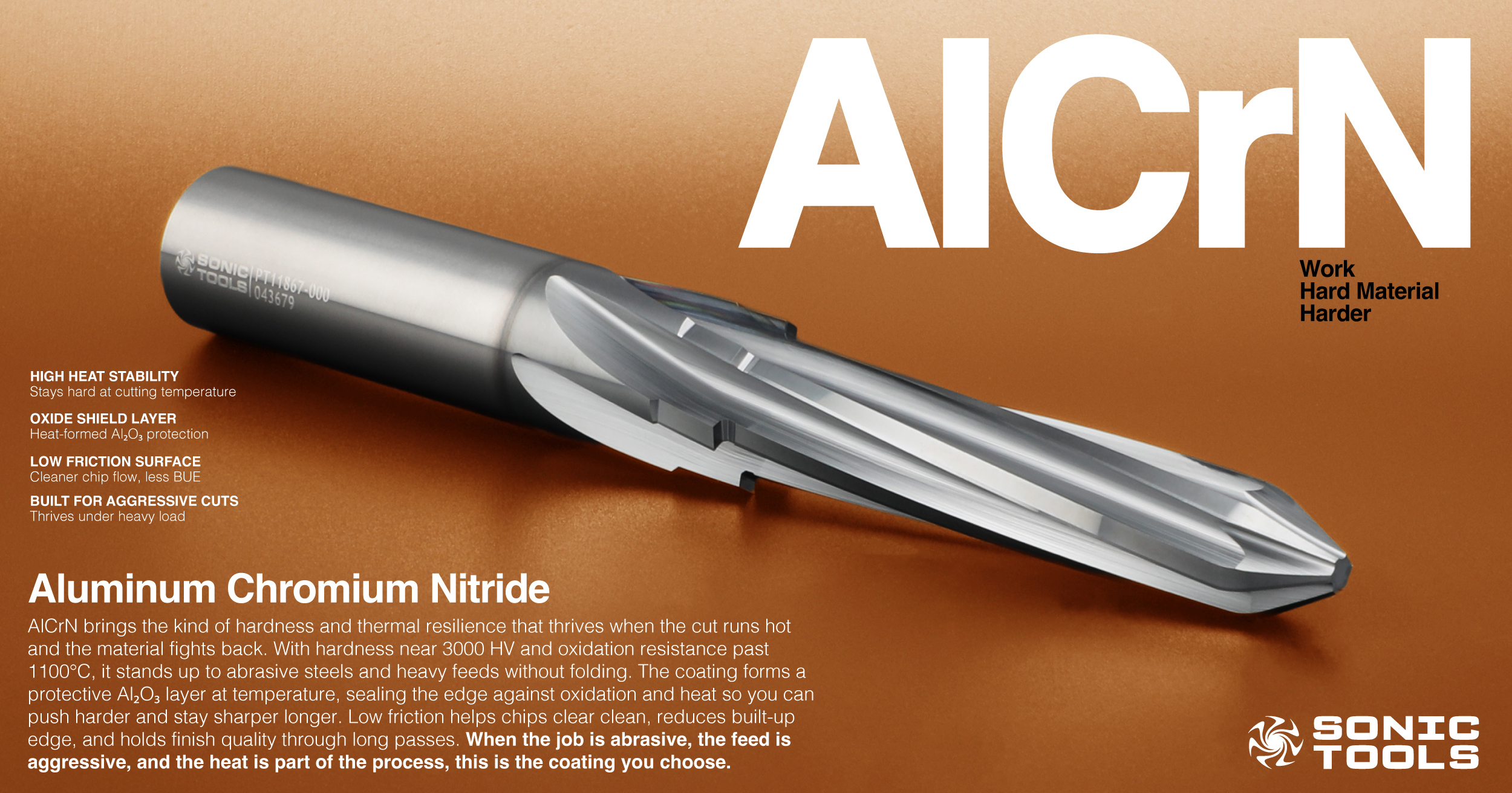
AlCrN (Aluminum Chromium Nitride) - The Utility Player
AlCrN, or Aluminum Chromium Nitride, was built on the same principle as AlTiN. The key difference between the two is the substitution of chromium for titanium.
Because AlCrN contains chromium rather than titanium, it offers better hardness and oxidation resistance than AlTiN. This is because aluminum bonds more readily to chromium, allowing a higher aluminum content in the coating.
As a result, AlCrN withstands higher temperatures than AlTiN. Its maximum working temperature reaches around 900°C - 1,100°C (1,652°F - 2,012°F), compared to AlTiN's 900°C (1,652°F).
For operations that generate extreme heat over sustained periods (hard milling, dry cutting of stainless or titanium at high speeds), the thermal headroom AlCrN provides improves tool life and consistency.
Quick Specs:
- AlCrN's hardness is around 32 GPa (3,300 HV)
- Its max working temperature is around 900°C - 1,100°C (1,652°F - 2,012°F).
- Same thickness as the others; no changes to the tool's geometry or the effectiveness of its cutting edge.
Important to Understand:
If you're working with stainless steel or titanium at aggressive parameters, or alloy steels at moderate speeds and dry conditions, AlCrN is optimal. For general carbon or alloy steels at moderate speeds and dry conditions, AlTiN remains viable and cost-effective.
The difference grows as demands increase: AlTiN suffices for everyday tasks; AlCrN excels as heat and stress rise.
AlCrN performs well in stainless steel, titanium, tool steels, cast iron, and difficult-to-machine materials. It doesn't need the extreme heat to do its job. It holds up across more of the middle range, too.
In hard milling of maraging and pre-hardened tool steels, AlCrN holds up better under sustained load. The documented difference in wear resistance is meaningful.
To put it plainly, the difference between AlCrN and AlTiN is the difference between a Ford F-150 and an F-250. They both do their jobs well, but if you need that extra muscle, the F-250 has you covered.
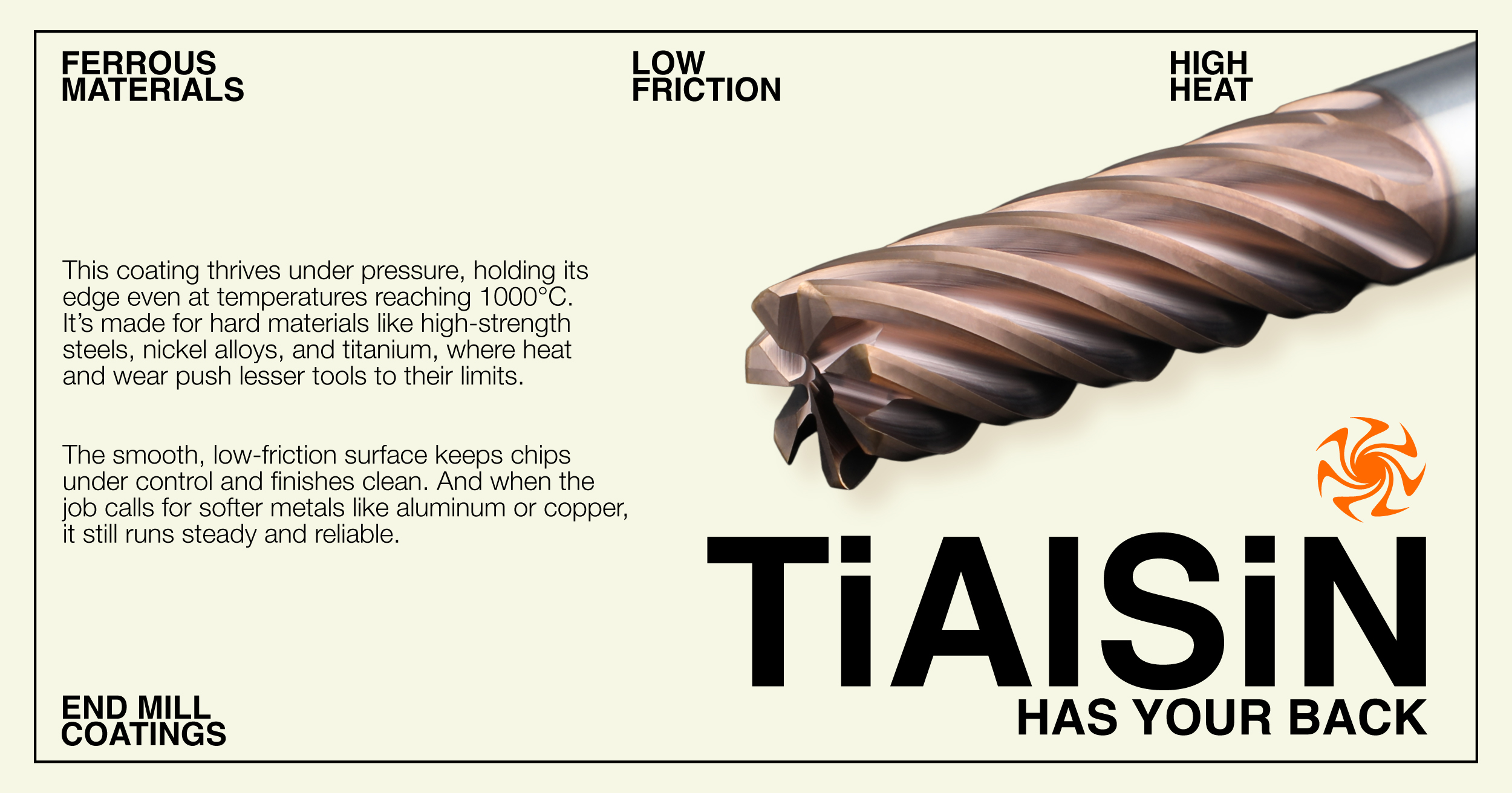
TiAlSiN (Titanium Aluminum Silicon Nitride) - The Tank
TiAlSiN, or Titanium Aluminum Silicon Nitride, is a chemistry word salad for good reason. It's a nanocomposite coating, which is a different class of coating entirely from the nitrides above. Adding silicon into the mix creates a two-phase nanostructure: TiAlN nanocrystalline grains embedded in an amorphous silicon nitride matrix.
To put it simply, TiAlN particles combine with silicon to create a reinforced shield for your end mill.
The result is hardness reaching 54 GPa (5,500 HV) and a heat threshold that clears 1,093°C (2,000°F), both significantly beyond what the nitride coatings above can offer. The silicon addition also reduces internal residual stress, helping it withstand interrupted cuts and the heat swings that come with aggressive work.
Quick Specs:
- TiAlSiN's hardness is around 54 GPa (5,500 HV).
- Its max working temperature exceeds 1,000°C - 1,200°C (1,832°F - 2,192°F).
- Same thickness as the others; no changes to the tool's geometry or the effectiveness of its cutting edge.
Important to Understand:
TiAlSiN is the most specialized coating we offer. It performs best in conditions that generate and sustain high heat.
If you're not going to be putting your tool through the wringer, simpler coatings may perform comparably at a lower price point. Since this coating is designed for hot and heavy applications, the nanocomposite structure's activation range won't be reached in lighter applications or at lower speeds, leaving its best properties untouched.
TiAlSiN is used for milling hardened steels (HRC 45 and above), demanding aerospace alloys, and applications where AlTiN and AlCrN get humbled. The performance gap in hard milling situations is well documented.
TiAlSiN is a tank.
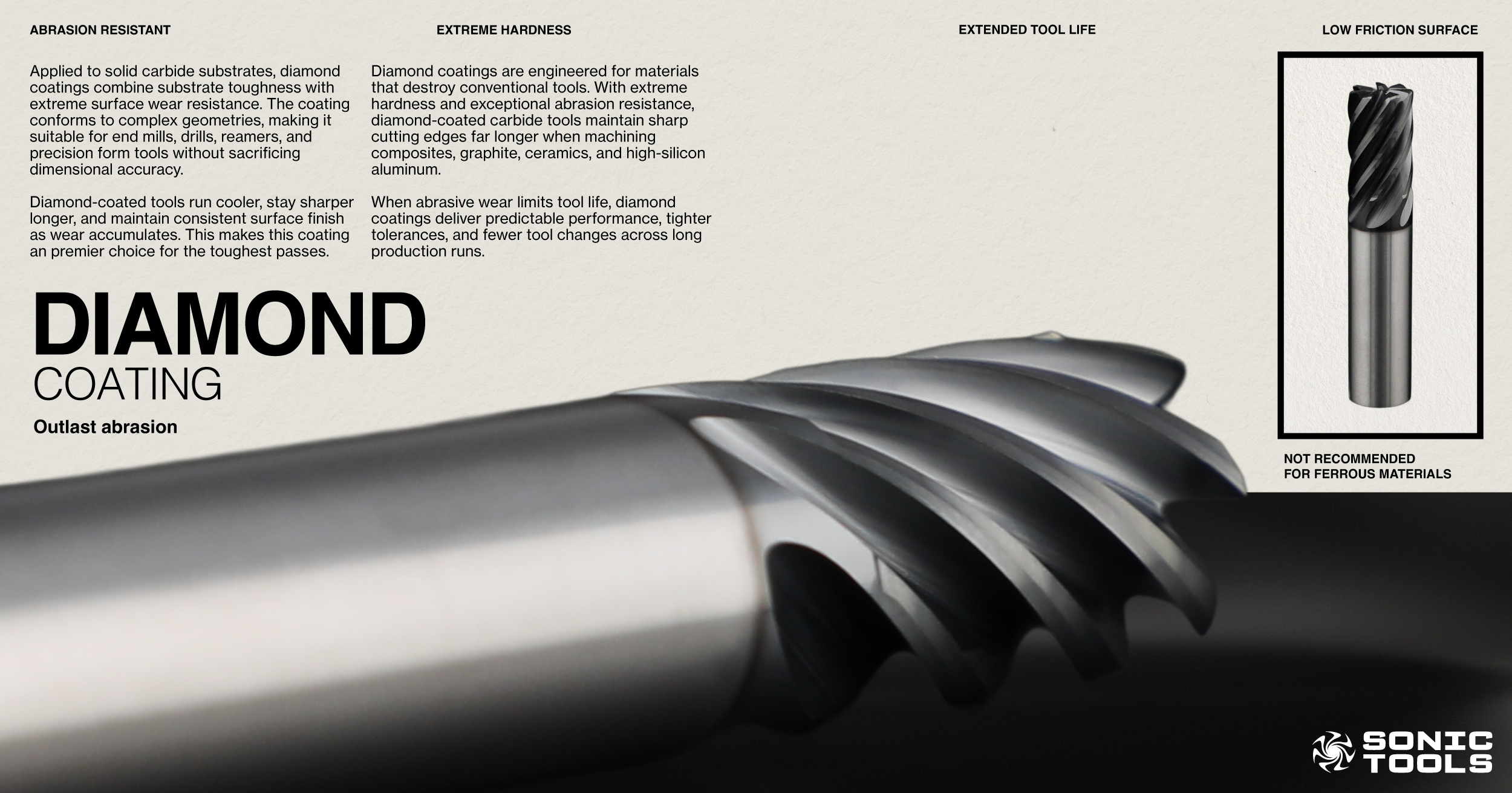
DLC (Diamond-Like-Carbon) or simply Diamond - Pressure Makes Diamonds
A DLC, or Diamond coating, is in an entirely different ballgame from the rest of the group.
While the TiN-based coatings undergo a reaction in the cut that boosts performance, a DLC coating falls into a different defining class of coatings, known as CVD coatings.
CVD (Chemical Vapor Deposition) is a process in which a coating applied to the cutting tool grows a crystalline diamond layer directly on the carbide substrate.
The result is the hardest coating available for a cutter, ranging between 88 GPa - 98 GPa (8,973 and 9,993 HV). Compared to every other coating we've discussed, this is several thousand HV harder. DLC coatings exist for one primary reason: abrasion resistance.
It's the right call for graphite, carbon fiber, composites, and abrasive plastics, which destroy standard carbide through abrasion rather than heat. High-silicon aluminum qualifies too, when the silicon content makes the cut abrasive.
Important to Understand:
DLC's limitations are worth knowing before you spec it.
Diamond coatings have a maximum working temperature of 600°C - 800°C (1,112°F - 1,472°F), which rules them out of any ferrous machining. The hardest coating available doesn't machine the hardest materials because machining these materials generates too much heat.
The second limitation is a documented trade-off regarding how CVD coatings are deposited.
Remember how we discussed that CVD coatings essentially grow more material as added protection? This means that this grown material also coats the tool's cutting edges, causing slight edge rounding during deposition.
This makes Diamond coatings less suitable for precision finishing work, where sharp edge geometry is of the utmost importance. An armored suit would make you less agile after all, wouldn't it?
We offer diamond-coated tooling solutions for applications where abrasion resistance can't be solved with other coatings. It's not offered as a standard order coating, but it's available in the lineup for jobs that warrant it.
Uncoated Carbide & Polished Fluting - Can Less be More?
Coatings do real work, but polished uncoated carbide still earns its place in certain setups.
For general aluminum machining at moderate speeds, polished and uncoated carbide mechanically minimizes friction and aluminum adhesion. Some machinists in aluminum-heavy shops choose to run polished tooling specifically for finishing work, where edge sharpness is prioritized over the lubricity gains a coating would deliver.
A machinist may also choose uncoated tooling depending on the system around the tool, particularly in applications with aggressive coolant concentration changes, interrupted cuts where thermal cycling would stress the coating, or situations where material chemistry would react with coating elements.
This is all to say that if someone tells you "any coated tool is better than an uncoated tool," they're speaking subjectively.
There's too much nuance in the decision framework for absolutisms.
Other Coatings Worth Knowing
The coatings covered above represent what Sonic offers and what you're most likely to encounter in a modern CNC environment. A few others come up regularly enough in shop conversations that they're worth knowing by name.
TiN (Titanium Nitride)
One of the oldest coatings in the industry. Its gold color makes it one of the most recognizable. It's a general-purpose coating for ferrous materials that predates most of what's covered in this post. It works, but most modern coatings have surpassed it in both hardness and heat resistance for demanding applications.
TiCN (Titanium Carbonitride)
Harder than TiN and handles moderate heat better, but its relatively low maximum operating temperature limits its usefulness in high-speed or dry-machining environments, where AlTiN or AlCrN are the stronger call.
ZrN (Zirconium Nitride)
One of the most relevant to Sonic's customers in specific circumstances. It's a non-ferrous coating with good lubricity and hardness, and it's most often used in highly abrasive aluminum alloys, such as high-silicon cast aluminum, where the abrasive load pushes conditions beyond TiB2's designed range. For standard wrought aluminum work, TiB2 remains the right starting point.
Sonic doesn't offer TiN, TiCN, or ZrN. If any of these come up for your application, reach out to our team, and we'll help you figure out the right direction.
End Mill Coating Chart
|
Coating
|
Application
|
Offered by Sonic Tools
|
Key Strength
|
| TiB2 |
Aluminum, non-ferrous |
Yes |
Low aluminum affinity, prevents built-up edge |
| AlTiN |
Steel, cast iron, titanium, Inconel |
Yes |
Heat-activated hardness, ferrous workhorse |
| AlCrN |
Stainless, titanium, tool steels, demanding conditions |
Yes |
Versatility, higher thermal ceiling than AlTiN |
| TiAlSiN |
Hardened steels HRC 45+, aerospace alloys, extreme heat |
Yes |
Nanocomposite hardness, highest heat resistance |
| Diamond (CVD) |
Graphite, composites, abrasive plastics, high-silicon aluminum |
Yes (specialty) |
Hardest coating available, maximum abrasion resistance |
| Uncoated/Polished |
General aluminum, moderate speeds, finishing |
Yes |
Sharp edge, no coating-material reactivity |
| TiN |
General ferrous, low-demand applications |
No |
Entry-level wear resistance |
| TiCN |
Moderate ferrous, lower speeds |
No |
Harder than TiN, limited heat range |
| ZrN |
Abrasive aluminum alloys, brass, bronze, copper |
No |
Lubricity and hardness in abrasive non-ferrous conditions |
Matching the Coating to the Operation
Choosing the right coating isn't as simple as "I need TiAlSiN-coated tools because I'm running them hot." The right coating choice comes from a combination of cutting conditions, material class, and tool geometry.
Here's how to work through the decision:
- Identify the Workpiece Material: Know whether you are machining aluminum, steel, titanium, composite, or another category. This determines which coatings are even in the running.
- Define the Operation: Are you roughing, finishing, profiling, or pocketing? Think about the type of cut, feed rates, and whether you're running wet or dry.
- Choose Proper Tool Geometry: Select the tool shape, flute count, and helix angle that best suit the material and operation. Geometry influences chip evacuation and coating performance.
- Select the Coating: Match the coating to your material, operation, and tool geometry. The right coating addresses the specific failure mode you're most likely to hit: adhesion, wear, or heat.
Below, I'll summarize a few quick recommendations to help you narrow down your options. These aren't to be taken without proper measurement on your end, but they may help you index these coatings in your head for when the time comes. Generally speaking:
Non-Ferrous:
- Aluminum: TiB2
- Highly abrasive aluminum: ZrN
- Graphite, carbon fiber, composites, and abrasive plastics: DLC (Diamond)
Ferrous:
Steel, stainless steel, cast iron, titanium, Inconel (general to demanding):
- Dry machining / general ferrous application: AlTiN
- Demanding conditions (stainless at aggressive parameters, titanium, sustained high-heat applications): AlCrN
- Hardened steels and extreme applications (HRC 45+): TiAlSiN
What Not to Use:
- For any ferrous materials: TiB2
- For aluminum: AlTiN
A Note on Coating and Geometry Together
Coating selection and tool geometry aren't isolated from one another.
A TiB2-coated end mill with a standard helix and a tight flute misses the point. The coating addresses adhesion, but the geometry still has to address chip evacuation.
A fully optimized aluminum finishing tool will typically feature a TiB2 coating, a high-helix, polished flute faces, and an appropriate flute count for the operation. Each element solves a different part of the same equation.
This same logic applies across materials.
For steels, pairing an AlTiN or AlCrN coating with a medium-helix (35-40°) geometry and a higher flute count gives you the wear resistance and chip control needed for tougher cuts, especially in dry machining.
When you're running titanium, a high-performance combo is an AlCrN-coated tool with variable helix geometry and lower flute count (such as 3 flutes). This combination reduces harmonics, improves chip evacuation, and helps you leverage the coating's thermal stability.
For hard milling of tool steels with a TiAlSiN-coated cutter, use a robust core, higher flute count for improved surface finish, and solid core geometry for maximum support under high loads. Whether it's stainless, cast iron, or composites, geometry and coating are both decisions. Make them together.
An AlCrN-coated tool paired with geometry that doesn't suit the material class is only solving half the problem. Coating is just as much a decision as tool geometry, and these decisions must be made in tandem.
Have a coating question specific to your application? We're easy to reach.
Frequently Asked Questions (FAQs)
Q: What is the best end mill coating for aluminum?
TiB2 is the standard for aluminum. Its chemistry resists the adhesion that causes built-up edge, keeping the tool-chip interface cleaner longer than most alternatives. For standard wrought aluminum like 6061, pair it with a high-helix, polished-flute geometry, and you have the right starting point for finishing, profiling, and pocketing work.
For highly abrasive grades like high-silicon cast aluminum, the abrasive load changes the equation. In those cases, diamond or ZrN coatings are better equipped to handle what TiB2 wasn't designed for.
Q: What is the best end mill coating for steel?
AlTiN covers most steel applications well. It's heat-activated, and at elevated cutting temperatures, the aluminum in the coating converts to aluminum oxide, forming a hard thermal barrier at the cutting edge exactly when the tool needs it.
That behavior makes it particularly well-suited to dry machining and high-speed cutting of carbon steel, alloy steel, and cast iron. When conditions get more demanding (stainless at aggressive parameters, titanium, sustained high-heat cutting), AlCrN is the stronger call.
Q: What is the best end mill coating for stainless steel?
AlCrN is generally the better choice for stainless steel over AlTiN. Stainless generates sustained heat and puts the cutting edge under consistent pressure throughout the run. AlCrN's higher thermal ceiling of around 1,100°C (2,010°F), compared to AlTiN's 760°C (1,400°F), gives it more room to work in those conditions without breaking down.
For lighter stainless steel work at moderate speeds, AlTiN remains a capable option. The gap between the two widens as conditions grow more difficult.
Q: What is the best end mill coating for copper?
Copper, brass, and bronze respond best to low-friction, low-adhesion tooling. Polished, uncoated carbide handles copper well at moderate speeds because the smooth flute face mechanically limits adhesion without a coating getting in the way. ZrN is the most commonly used coating in this space, offering hardness and lubricity in non-ferrous conditions where TiB2's aluminum-specific chemistry isn't required.
One thing to avoid: coatings with high aluminum content, such as AlTiN.
The aluminum in the coating reacts with non-ferrous workpiece materials, producing chip welding and edge buildup rather than preventing it.
Q: What is the best coating for carbide end mills?
The honest answer is that it depends on what you're cutting. TiB2 for aluminum. AlTiN for general ferrous work. AlCrN when conditions get more demanding. TiAlSiN for hardened steels and extreme heat. Diamond for abrasive non-ferrous materials. The coating that performs best is always the one matched to the specific failure mode the application is most likely to produce.
A coating that's excellent in one material can actively cause problems in another. Start with the material, define the operation, then pick the coating.
Q: What is the difference between AlTiN and AlCrN coating?
Both are nitride coatings built for ferrous machining, but the chemistry differs in one meaningful way. AlTiN uses titanium as its base element. AlCrN swaps titanium for chromium. Because aluminum bonds more readily to chromium, AlCrN can contain a higher aluminum content, resulting in better hardness and oxidation resistance. The practical result is a higher thermal ceiling: AlCrN withstands around 1,100°C (2,010°F), compared with AlTiN's 760°C (1,400°F). For general steelwork at moderate speeds, AlTiN remains a capable and cost-effective choice.
For stainless, titanium, or anything running hot and dry for extended periods, AlCrN holds up better.
Q: What are the disadvantages of DLC coating?
There are two disadvantages worth knowing before you spec DLC. First, the maximum working temperature is around 600°C - 800°C (1,112°F - 1,472°F), which rules out DLC for ferrous machining completely. The heat generated by steel, stainless steel, and other hard metals during cutting exceeds what the coating can withstand. Second, the CVD deposition process grows the diamond layer directly onto the carbide substrate, including the cutting edges. That causes slight edge rounding during deposition, making DLC a poor fit for precision finishing work where sharp edge geometry is the priority. DLC earns its place in abrasive non-ferrous applications.
Outside of that, those two limitations are hard to work around.
Q: Is nitride or DLC better?
Neither is better in any general sense. They solve different problems. Nitride coatings such as AlTiN, AlCrN, and TiAlSiN are designed for ferrous machining, where heat resistance is the primary requirement. DLC is designed for abrasion resistance in non-ferrous and composite materials where heat isn't the main failure mode. Run a nitride coating in graphite or carbon fiber, and it wears through abrasion. Run DLC in steel, and it fails from heat.
The right question isn't which is better. It's the failure mode your application is most likely to produce, and which coating is built to address it.
Other Helpful Guides & Resources: