What Sets Center-Cutting End Mills Apart
Posted by Cam Glass on 11.24.26
Every end mill has teeth on its end face. Not every one cuts at the center.
The question usually comes up when a tool path needs the bottom of the cutter to touch the part: a closed pocket, a plunge, or a helical bore deep enough to wipe the floor. That’s when it matters whether an edge on the end face reaches the center.
What does center cutting mean on an end mill?
A center-cutting end mill has at least one end cutting edge that extends to or past the tool’s axis. This lets it cut straight down into solid material with its end face, in addition to cutting with its peripheral edges.
A non-center-cutting end mill isn’t a flat cylinder on its end face. It still has cutting edges there, but they stop short of the axis, so it can’t cut straight down into solid material.
Think of it like a car buffer with a hard plastic plate in the middle of the pad. You can still buff with the outer ring if you angle it, but if you set it flat on the door, that plate scratches the paint. A non-center-cutting end mill has the same problem at its center.
End-face teeth don’t make it center cutting. End-face teeth that reach the tool’s axis do.
How do you tell whether an end mill is center cutting?
Identifying a center-cutting end mill should be simple, but it can get tricky depending on the tool, the manufacturer, the tool’s history, and the end-face geometry.
The quickest read is a look at the end face. The surest one is the spec.
Visual inspection
To start, a simple visual inspection of the tool’s end face will usually reveal whether an end mill is center cutting or non-center cutting. To check, look at the tool’s end face and look for at least one long tooth reaching the tool’s center axis.
If you see a cutting edge in the middle, the tool is likely center cutting.
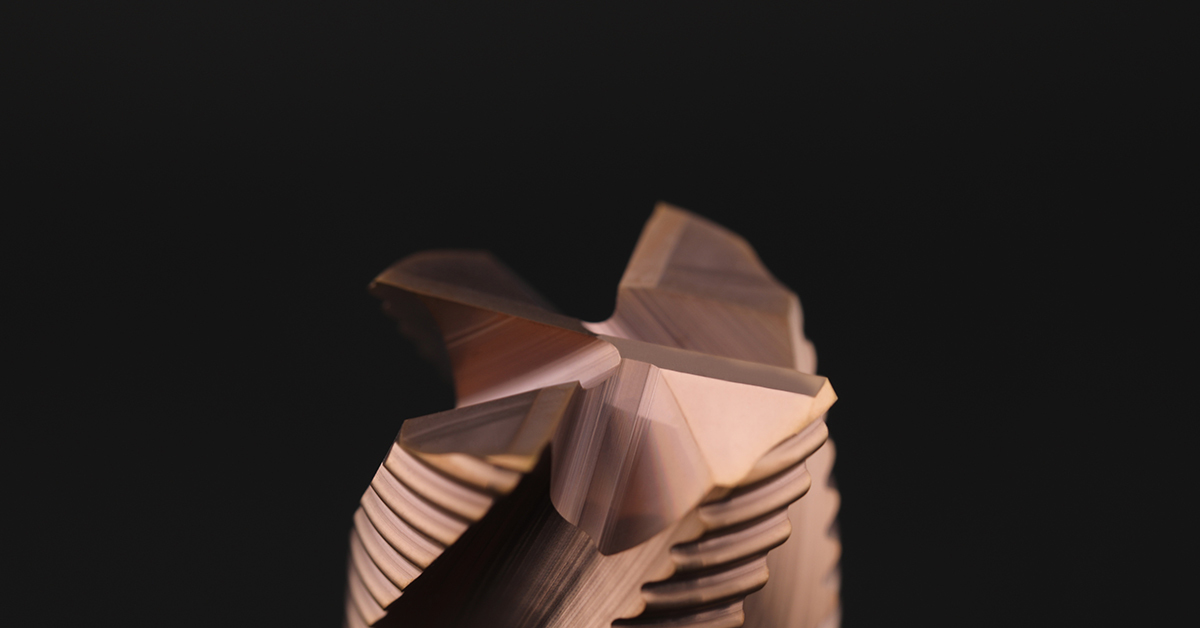
Cutting end of a 4-flute 100R Series roughing end mill with serrated flutes. Two of the four cutting edges on the end face reach center.
Important to Understand
Gash and notch grinds near the center can make an edge look like it reaches the axis when it stops short.
For a closer look, put the end face under whatever inspection equipment your shop has: an optical comparator, a vision system, a tool presetter with a camera, or a CNC tool-measuring machine.
You don’t need the most advanced machine in the building for this. You need one that clearly shows whether an edge reaches the center.
Check the spec
If your tool is relatively new, common, frequently reordered, or traceable in any way, the most reliable way to confirm your end mill’s geometry is to check the manufacturer’s specs. If your tool is a manufacturer standard line item, you can find its specs on the manufacturer’s website or in the catalog.
Even a quick search of the SKU on the tool’s shank, or a check of the information on its tube, can usually tell you the specs.
If nothing else reveals the tool’s specific geometry, the spec will. One exception: if the tool’s been reground, check the tool itself, since a regrind can change the end face.
Your eyes can get you close. The data gets you across the line.
Flute count won’t tell you, and neither will hearsay
If you’ve heard that flute count is a quick indicator of center-cutting geometry, you’ve only heard half the story.
Misconceptions, like the idea that 4-flute end mills “can’t plunge,” or that all flutes on a center-cutting end mill extend to the axis, are myths that mask themselves as common knowledge.
Neither one holds up in solid carbide. Center-cutting 4-flute end mills are standard catalog items, and distributors carry carbide end mills with many different flute counts listed as center cutting. One toolmaker may list a center-cutting 6-flute and a non-center 7-flute in the same catalog, so flute count can’t reliably indicate end-face geometry.
Also, flute count won’t indicate how many flutes extend to the axis on an end mill. Since a center-cutting end mill creates chips at the tool’s end face, the tool needs a way for those chips to evacuate the cut. If every flute’s cutting edge reaches the axis, there’s no space on the end face for gashing or relief geometry to route the chips away.
Making assumptions about center-cutting geometry can burn you later, so source reliable information and do your due diligence before trying to cut with the end face.
Can you plunge or ramp with a center-cutting end mill?
Center-cutting geometry gives an end mill more ways into the part, including entry moves a non-center tool can’t make. The chart below compares what each type can do:
| Center cutting | Non-center cutting | |
|---|---|---|
| Plunge into solid material | Yes, but it’s the hardest entry on the tool | No: the center of the end face runs into the part |
| Ramp or helix in | Yes; simulate the ramp first | Depends on angle of entry and cutter end-face geometry |
| Drop into a pre-drilled hole | Yes | Yes, if the hole is wide enough to clear the tool’s center |
| Chip room at the end | Less (carbide at center) | More |
| Tip strength | Edges to center add strength | Nothing at the tip for strength |
Plunge: straight down the Z axis into the part. Ramp: feeding sideways while stepping down at an angle. Helix: a circular path while Z steps down.
Which one you pick depends on the part, the machine, and the milling strategy you need or choose to execute.
What about a closed pocket?
No open side means the end mill has to enter the pocket from above.
While a non-center-cutting end mill could lightly ramp into the pocket, coming down into the workpiece with a center-cutting end mill is the cleanest way to enter a closed pocket.
Plunging is the most direct entry, but it’s also the hardest on the tool. A helical entry is the gentlest, with ramping in between.
Cutting a closed pocket in aluminum? Our 200C is a 3-flute end mill with chipbreakers, and it’s center cutting in every size, with one edge to center so that it can ramp or plunge into the pocket it’s about to clear.
Plunging with a center-cutting end mill
A center-cutting end mill can plunge directly into a workpiece, but it’s not a drill.
If you’re looking for a hole-making tool or need to plunge deeply, you’re better off using a drill and creating a pilot hole than just driving your cutter straight down.
Why? For one, a drill’s job is to make holes. End mills also aren’t built to cut straight down and clear chips out of a hole the way a drill is. A center-cutting end mill can plunge, but for volume work, go with a drill.
Our 7-flute 170 is center cutting, but seven flutes leave little room for chip evacuation, so we wouldn’t plunge with it. For a plunge, a 3-flute like the 200 or 110 is the better pick.
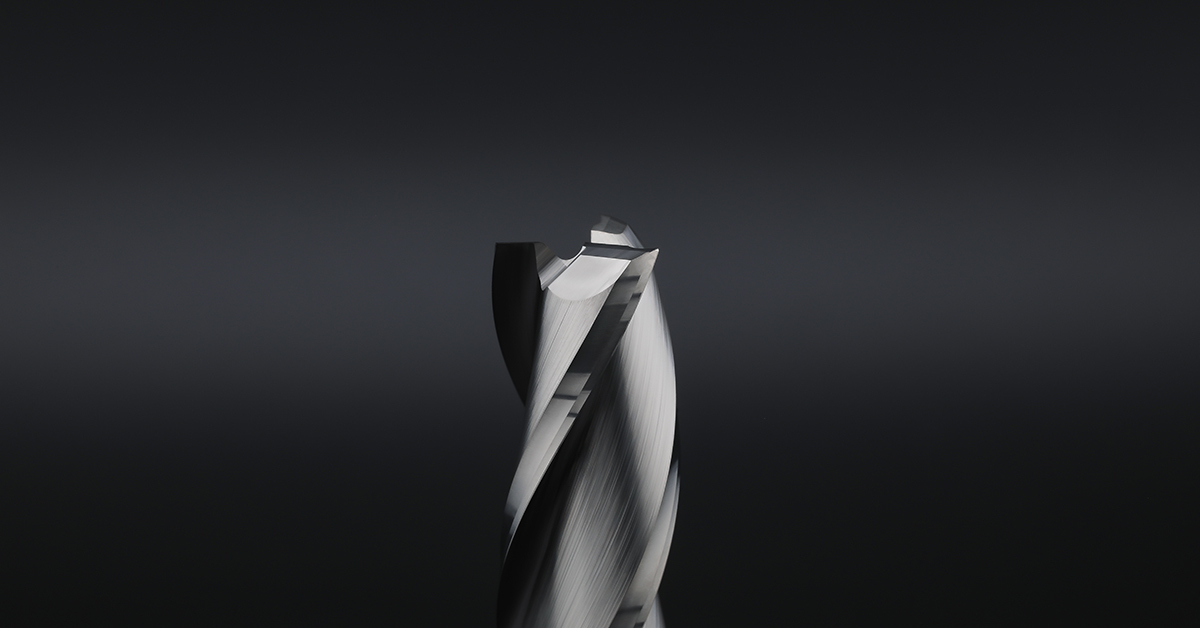
Silver 3-flute 200 Series end mill on a dark background. The most forefront cutting edge on this tool’s end face reaches or surpasses center.
Just because you can doesn’t mean you should.
Ramping isn’t free either
While you can ramp with both a center- and non-center-cutting end mill, that doesn’t mean ramping should be your go-to entry strategy.
Ramping comes with risks, even with a center-cutting end mill. Make sure to check a ramp in simulation before going ahead, since adding an angle to your entry approach adds new variables to watch out for. Safe ramp angles shift as variables change, so it’s good practice to modify your ramp angle as the tool, material, and end geometry change.
When is a non-center-cutting end mill enough?
A center-cutting end mill can make every entry a non-center tool can, plus a straight plunge.
A non-center-cutting end mill is a good choice whenever its center never has to push into solid material, as with side milling and profiling. It’s fine to use when the tool path brings it in from the side, down a shallow ramp, or into a pre-drilled hole, as long as its center never meets solid material.
Important to Understand
Our team has seen what happens when it does: a non-center tool with a coolant hole in the middle, run with the coolant off, gets jammed with material pretty quickly and binds in the cut. The tool didn’t break, but it wasn’t good for the operation afterward.
A non-center end mill can ramp in. It just can’t let its center touch the part.
That’s not a knock on the design. Plenty of these tools are built that way on purpose. In solid carbide, you’ll most often find non-center geometry on high-flute finishers and on coolant-through tools with a hole in the center.
In these operations, non-center-cutting tools work efficiently because the center of the end face never has to cut. The lack of cutting edges to or past center opens up additional space for coolant holes.
Our 190 series is a 9-flute finishing end mill, and it’s the only standard end mill we make that isn’t center cutting. On finishing tools with high flute counts, the end face is often very busy since it holds geometry from each tooth.
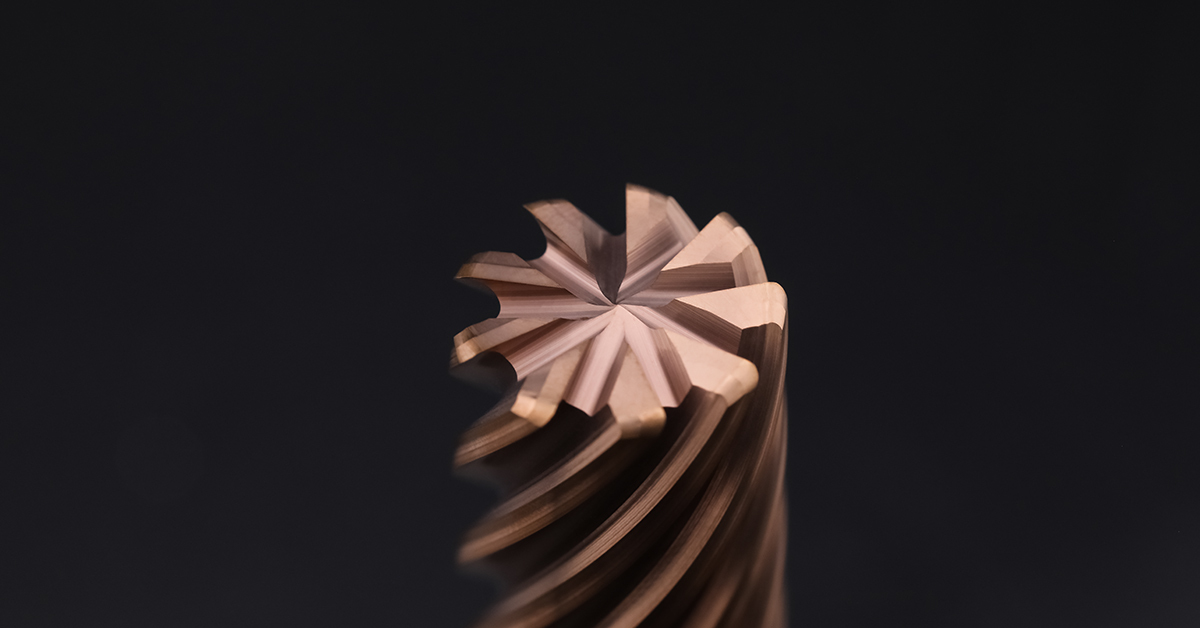
End face of our 9-flute 190 Series finishing end mill. Since the end face is too busy already, center-cutting geometry isn’t feasible for the 190 series.
Busy end faces typically don’t incorporate center-cutting geometry because there isn’t enough chip room to evacuate material adequately. And since the end face is already so busy, the grinding wheels that carve the geometry into the end face don’t have enough room to operate without potentially jeopardizing other end-face geometries.
Which Sonic end mills are center cutting?
Every standard series end mill we offer, minus the 190 series, is center cutting.
Below is a quick-reference chart of our standard end mill lines, including flute counts, a quick check for center-cutting geometry, how many edges each series line features, and links to learn more about any specific series you’re interested in.
| Series | Flutes | Center cutting? | Edges to center |
|---|---|---|---|
| 100, 100C, 100R | 4 | Yes | 2 |
| 110 | 3 | Yes | 1 |
| 200, 200C | 3 | Yes | 1 |
| 240 | 2 | Yes | 1 |
| 120 / 220 (ball nose) | 3 / 2 | Yes | 1 / 2 |
| 150 | 5 | Yes | 1 |
| 170 | 7 | Yes | 1 |
| 190 | 9 | No | 0 |
FAQ
How do I know if my end mill is center cutting?
Look for at least one end cutting edge that runs to the center of the end face. That’s a good first read, but gash and notch grinds near the center can make a tool look center cutting when the edge stops short. The reliable answer is the maker’s spec: catalogs list it, and most distributors let you filter by it. If you can’t trace the tool, put the end face under whatever inspection equipment your shop has. Don’t touch the edges to feel for it. Contact can chip a sharp carbide edge, and touch can’t tell you whether an edge stops just short of center.
Can you drill with an end mill?
A center-cutting end mill can cut a hole, but it’s a poor stand-in for a drill. An end mill isn’t built to cut straight down and clear chips out of a hole the way a drill is, so for standard hole sizes we’d recommend a drill, especially for small, long holes. The bottoms come out different too: an end mill leaves a nearly flat bottom, a drill typically leaves a cone. When a hole needs long reach, an odd size, or special clearance, we make custom drills.
Can a non-center-cutting end mill plunge?
Not straight down into solid material. Its end edges stop short of the axis, so its center hits the part like a blunt post. It can ramp in or drop into a pre-drilled hole, as long as its center never meets solid material.
Are all Sonic end mills center cutting?
All of our standard end mills are, except the 9-flute 190 series. With nine flutes, there isn’t room on the end face for chips, or for the grinding wheel to bring an edge to center without wiping out the rest of the geometry. The table above lists each series, its flute count, and how many edges reach center.
Is a ball nose end mill center cutting?
Ours are: the 120 and 220 series are ground past center. The catch is the very tip. Right at the axis, the edge has no surface speed, zero SFM; Modern Machine Shop puts it as “the relative cutting speed is lower at the center of the tip.” That dead spot can leave swirl marks on a finish pass, which is why we grind past center to cut them down.
What’s a slot drill?
It’s the ISO and UK name for a center-cutting end mill with two flutes. ISO 10911, the international standard for solid carbide end mills, says two-flute end mills “shall be centre-cutting (slot drills),” and three flutes or more “may be.” A slot drill both creates slots and drills. If a catalog lists a slot drill, read it as center cutting.
Whatever the catalog calls it, the test is the edge at the center. We grind every end face in-house in Ashland, Virginia. If you’re not sure which series fits the way your part needs to be entered, ask us. If nothing in the catalog does what you need, we’ll build one that does.
Find a center-cutting end mill.
Better Tools. Better Results.