
How to Get a Custom Carbide End Mill Made
Posted by Cam Glass on 06.04.26
The off-the-shelf ran out but the job's not done. Here’s how to get a custom tool built right the first time.
By the time most engineers go looking for a custom carbide end mill, they’ve already lost the argument with the catalog. The reach isn’t on any neck chart. The form doesn’t exist as a stock profile. The material wants a coating and substrate pairing that nobody stocks.
You scroll through three suppliers’ pages and land on the same answer: this one has to be built.
Creating the tool itself is the easy part. The actual challenge in creating a custom carbide end mill lies in everything that comes before the tool's grinding, referring to the information gathering, the back-and-forth over specific questions, requests, and clarifications, and the challenge of getting it all done in a promised lead time that outpaces the competition.
That part is almost entirely on you. How quickly custom cutting tools come together has less to do with our machines than with what you put in front of us at the start.
Every blank we have to fill becomes an assumption. Every assumption becomes a feature on the first article. And the first article is where you find out which ones were wrong.
Where this applies
When the catalog stops being the answer
A catalog is a menu. It covers the dishes most kitchens order most often, and for the large majority of jobs, that’s all you need. Standard solid carbide end mills are built to cover a wide range of work, and they cover it well.
Sooner or later, though, a job asks for something that isn’t on the menu. It usually shows up as one of three signals.
Your reach runs past the standard neck length. Catalog neck lengths and diameters are typically fixed and listed depending on their usefulness. But, when you need to cut a deep feature and the length-to-diameter ratio crests 3:1 with no room for a bigger shank, the only way to maintain rigidity and preserve tool life is a neck that’s ground for the exact reach needed.
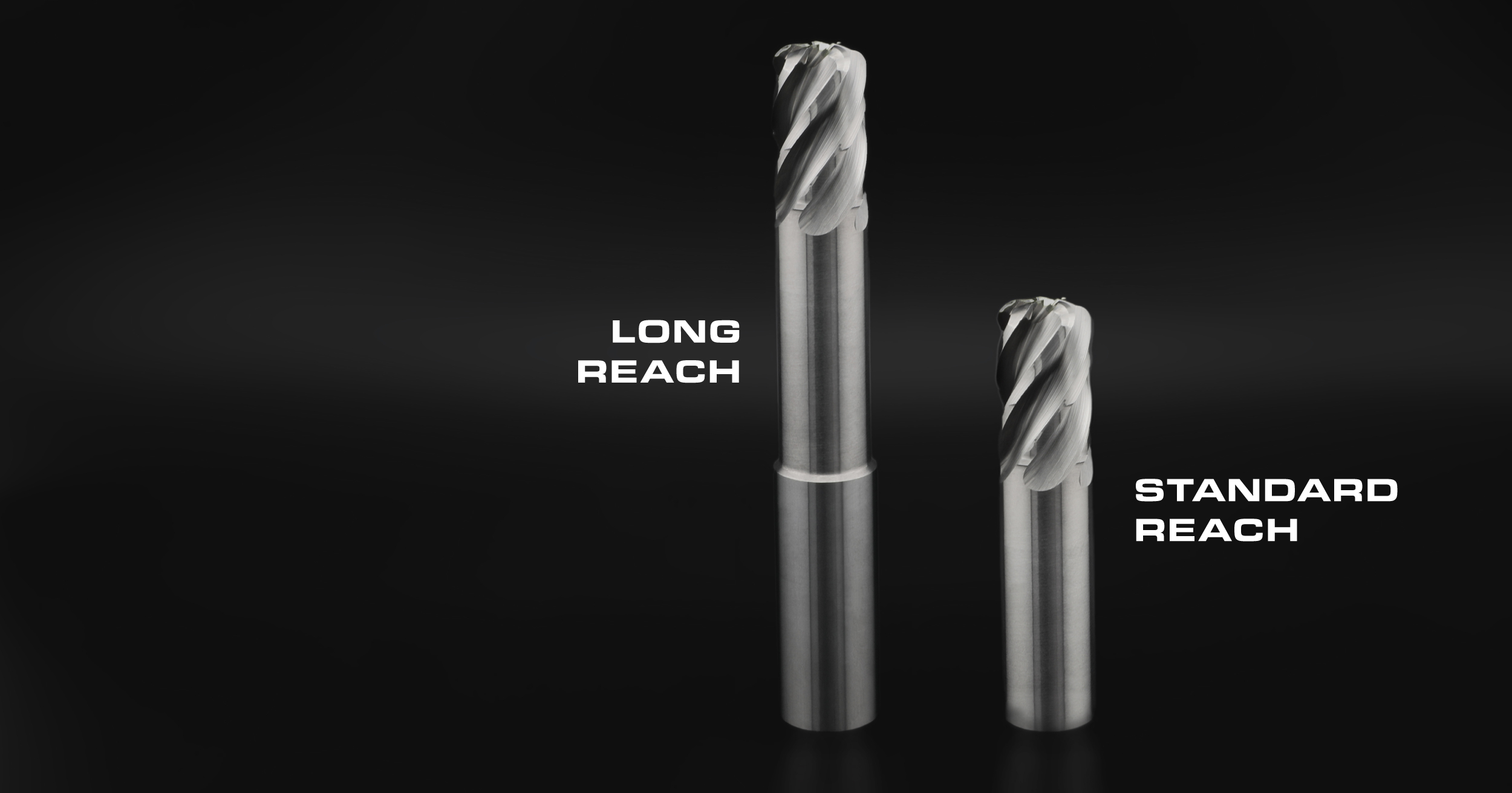
Long-Reach Custom Carbide End Mill vs. Standard-Reach End Mill | SONIC TOOLS
The form can’t be found anywhere. Another tip off that you’ll end up needing a custom tool is that the form you need isn’t available anywhere online or in catalogs. Forms you’ll usually never see spec’d exactly as you need them include stepped tools with multiple diameters, profile cutters built to machine features in a single pass, and, especially, any proprietary form built from your tool print.
If you were to find a tool like any of these in a catalog in your exact dimensions, grab a lottery ticket on the way home. These tools are usually drawn from your geometry and the constraints around it. You won’t find tools like these already available. You built the tool in your brain, and the manufacturer brings it to life.
The coating and substrate pairing isn’t stocked. Catalog tools ship on a short list of coatings over a limited set of substrate grades. A job that needs TiAlSiN on a cobalt-grade substrate to machine hardened stainless above HRC 45 is asking for a pairing no catalog carries. A custom build can apply any coating to any substrate required.
Here’s how you’ll know for sure that the catalog isn’t the answer this time: If your standard tool is wearing early or leaves a subpar finish that you can’t seem to fix, and you’ve double-checked that your speeds and feeds are accurate, you’ve got a geometry issue. The problem isn’t your numbers; it’s just time to explore custom tool construction.
A custom carbide end mill starts with constraints, not geometry
Before any geometry gets drawn, a custom tool is defined by what can’t change in your application.
Think of the next six as the measurements a tailor takes before cutting cloth. Hand over all of them, and the tool gets built to fit. Skip one, and we’re guessing at your inseam.
1. Workpiece material
The material that you’ll be machining plays a huge role in building the foundation for your custom tool. Various specs are determined directly from your workpiece’s material class, including the tool’s substrate grade, coating chemistry, and edge prep.
For example, if you’re going to be cutting aluminum, your tool should probably have a polished flute face and a TiB2 coating to prevent chip welding, typically combined with a lower flute count as well.
In contrast, cutting hardened steel above HRC 45 usually takes a fine-grain substrate and a coating built for temperatures over 1000°C, so TiAlSiN meets the mark. If you’re working with titanium and/or Inconel, you’ll want a positive rake angle above +20° and either TiAlSiN or AlTiN to keep heat away from the edge.
Give the exact alloy rather than the family. Just listing “aluminum” is like giving your friend the town you live in, rather than the address they’ll need to actually meet you. 6061-T6 and 7075-T651 produce different tools, and the designation determines whether your tool is effective.
2. Machine and spindle
Your machine’s rigidity will decide how much deflection the tool can take before it fails, and the same long-neck design will behave differently in a rigid VMC than in a 30-taper machine with less torque to give. The spindle interface and available torque also point to the flute-count decision for a given diameter and reach.
State your spindle interface (BT30, BT40, CAT40), the maximum RPM, and your coolant delivery method. How you decide to apply coolant to the cut shapes the geometry as much as the machine does.
3. Workholding and clearance
The type of workholding you employ determines the approach angle and the radial clearance the tool works with in the cut. Whether you’ll be using a vise, a tombstone fixture, a trunnion, or another workholding method, each presents the tool differently, and clamps or fixture walls near the cut can box the tool body in.
Also, map the obstructions in the toolpath before creating any drawings. These set the minimum neck length and body clearance that the design respects, and the minimums usually determine the rest.
4. Operation type
Naming your operation type fundamentally changes the tool’s build just as much as the other constraints. Whether you’re slotting, side milling, profiling, plunging, or performing any other operation, the mechanisms used will load the tool differently.
If you’re doing full-width slotting, you’ll want a thicker core to maintain rigidity. If you’re profiling, you can utilize more flutes at speed because your vibration levels are lower. Chamfering, threading, and forming each require their own geometry. If you run the wrong geometry for the operation, you’ll see it reflected both in the cut and on the tool itself.
Name the function, not just the material. “Profiling 17-4 PH” tells a more complete story than just listing “stainless”.
5. Reach and neck clearance
Neck diameter, neck length, and shank dimensions follow from your reach and depth of cut. The further the tip sticks out, the more it acts like a diving board: same load, more deflection, and you feel it in both tool life and finish.

Reach and Neck Diagram of a Sonic Tools Custom Form Tool | SONIC TOOLS
If the job runs to a 4:1 reach-to-diameter ratio or beyond, say so up front. If a tolerance caps the amount of deflection you can live with, say that too.
6. Tolerance and finish
The tightest tolerance you can work with will drive the edge prep, helix angle, and the cutting parameters recommended to you. A ±.0001" position tolerance on a profile necessitates a different edge than a roughing pass does. A surface finish target in Ra or Rz alters the flute count, helix angle, and chip load.
Make sure you’re listing the tightest tolerance the job actually holds, and don’t tighten it for safety. Speccing a tolerance the tool doesn’t need is like ordering surgical instruments for cutting plywood. You’re coming out of pocket for levels of meticulousness that the job doesn’t ask for, and you’ll pay for it again every time you decide to reorder.
Custom tool input sheet
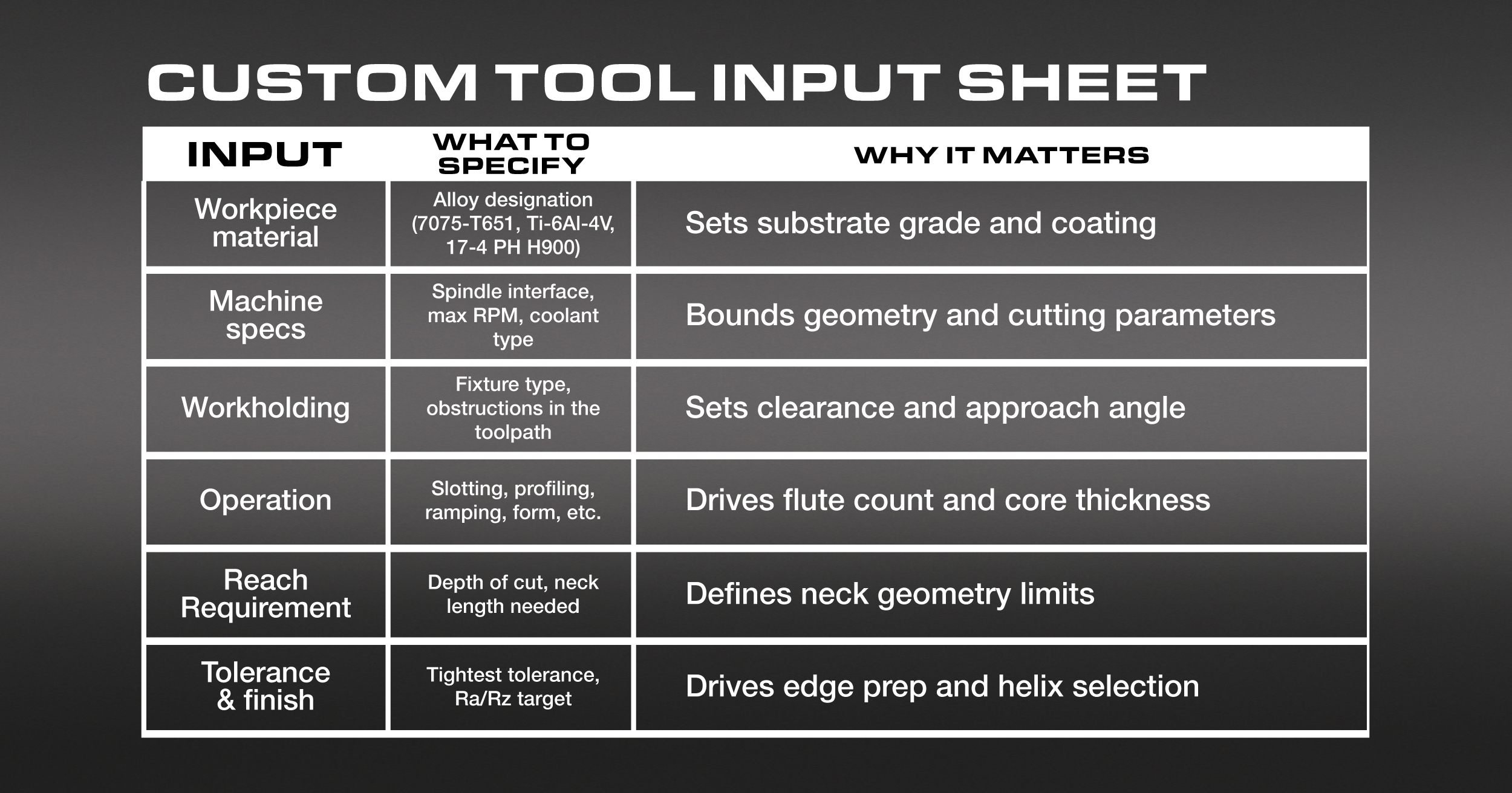
Custom Carbide End Mill Input Sheet — Six Constraints for Design and Quoting | SONIC TOOLS
Fill in all six, and there’s nothing left to assume.
Writing an RFQ that gets quoted fast
A complete RFQ does three things: shortens the quote, cuts the rounds of back-and-forth, and raises the odds the first article runs to spec.
Most requests that stall, stall in the same spot. We need a constraint that wasn’t in the RFQ; the quote is waiting on your answer, and the lead time you were trying to protect is starting to stretch.
A custom request that moves lists all six constraints up front, plus a few things that make the quote accurate:
- A drawing or sketch of the tool; extra points for showing the feature being cut
- Order quantity: the first buy and the estimated annual volume, as both shape setup and final price
- Your target delivery window and any hard ship date
If you’re already running a tool that’s doing the job, but you notice a sizeable performance gap to fill? Send the tool in, too. We can measure it, sniff out the issues, and determine the necessary fixes for the next version faster than you can describe the problem in an email.
If you don’t have every constraint tacked down, start the conversation anyway. A good custom tooling process starts by aligning constraints before any geometry is defined, so the gaps close before you ever run the first article. It’s okay to slow down and get specific; the correct tool will end up in your spindle.
A short intake isn’t the same as an efficient one. When the manufacturer quotes the custom without asking about the material, machine, or tolerance, those answers get filled with assumptions. If you’re being asked about quantities before constraints, it’s fair to ask whether the manufacturer is building the tool you need or the tool that gets you out the door quicker.
The coating is part of the spec, not a finishing detail
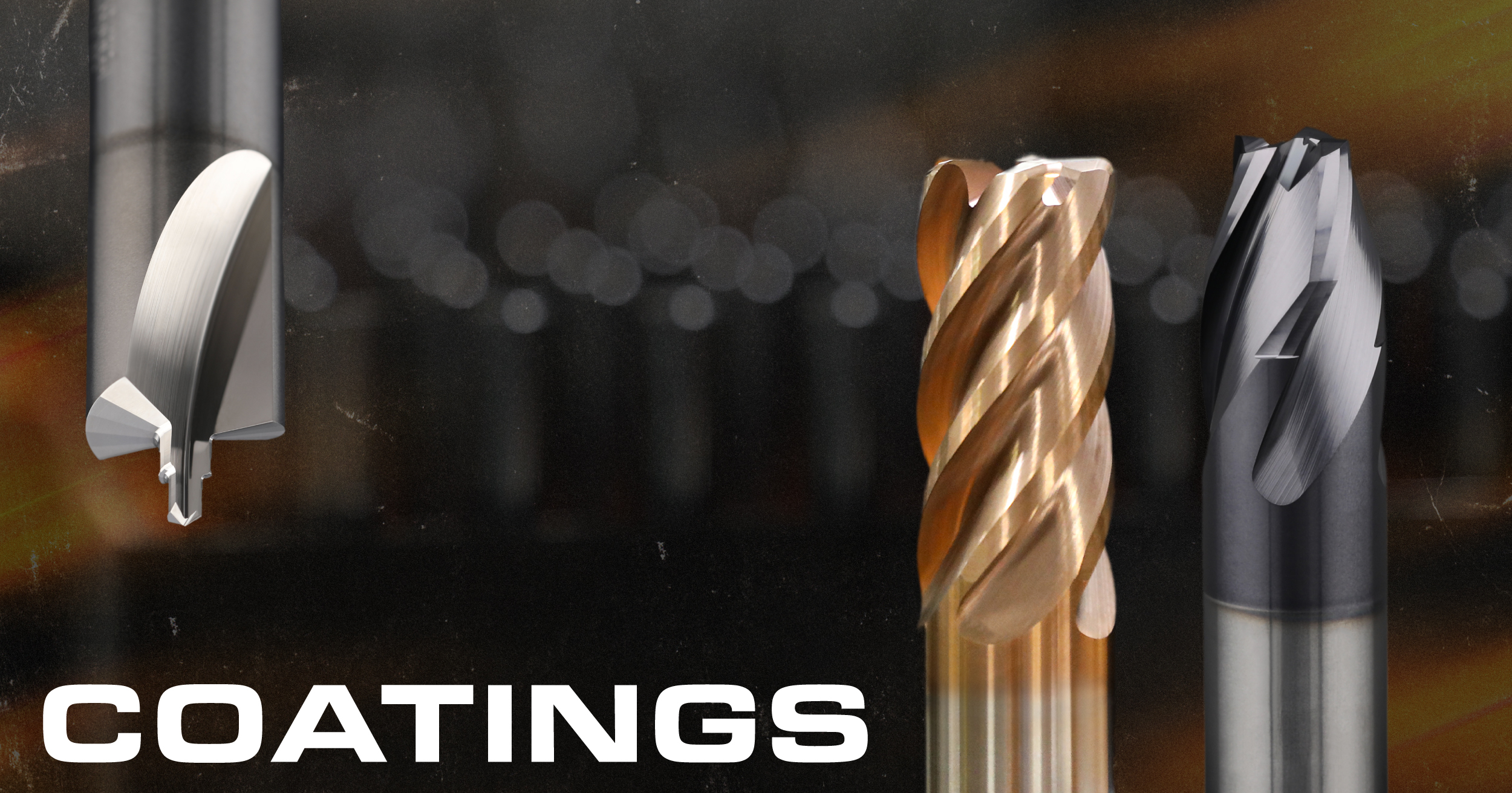
Carbide End Mill Coating Comparison | SONIC TOOLS
We receive custom requests all the time with the geometry dialed in and the coating option left blank, as if it’s a decision for later or something the shop will just slap on before shipping.
This is backward.
Specifying the geometry and leaving the coating open to interpretation is like building a racing engine and letting the guy at the auto parts store pick your fuel for you. The coating is integral to the tool, and picking TiB2 when you need AlTiN gets you wildly different chip formation, heat behavior, and finish quality.
Coating follows the material and the cut, just as geometry does. TiB2 on an aluminum tool fights the chip welding that wrecks a finish. That same TiB2 on a tool meant to finish hardened steel is being used outside its intended purpose. It isn’t a default to fall back on. It follows the job. (Our coating guide walks through the choice material by material.)
A coating won’t rescue a tool's inaccurate geometry. A 7-flute tool ground for finishing hardened steel doesn’t become an aluminum finishing tool because you coated it with TiB2. The tool’s geometry determines whether it’s the right one for the job. The coating assists with performance and tool life thereafter.
Spec them together unless you only want to solve half the problem.
Domestic and offshore aren’t the same purchase
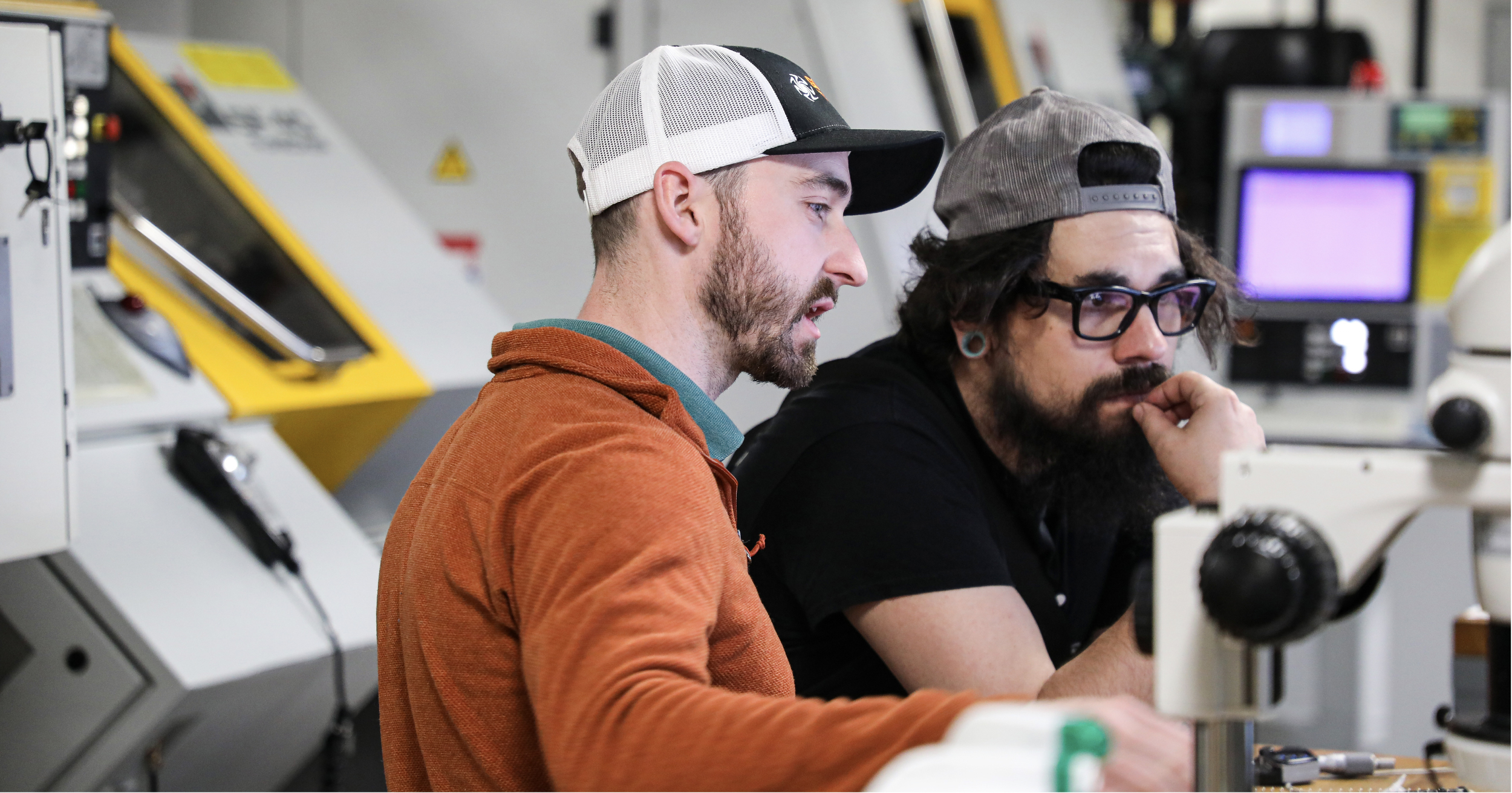
A Sonic Tools Engineer and Machinist reviewing custom carbide tooling specs at the Sonic Tools Machine Shop in Ashland, Virginia | SONIC TOOLS
When the engineer who designed the tool and the machine that grinds it are right next to each other, three things change in the process: how fast you can spec your tool, how fast revisions are made, and how predictable the lead time is.
On a standard order, this is typically a non-factor. On a custom job, it’s paramount to process efficiency.
In this business, offshore manufacturers and their hyper-competitive pricing typically win the first order, unless domestic manufacturing is more convenient or preferred. However, once the tool needs a geometry correction (complex tools typically require at least one), sending the correction overseas is like troubleshooting a chatter issue via email.
You know exactly what needs to change, but getting it through a sales rep, a translation, and a time zone change can start to drag your lead times through the dirt. What we can settle in a phone call and a walk across the floor can cost an offshore vendor several revision cycles, and the price that once put domestic manufacturers to shame unmasks as an entry point into a costly and time-consuming process.
Here’s roughly how domestic vs. offshore manufacturing stacks up on a first custom run:
|
Domestic/in-house grinding
|
Offshore | |
| Iteration | Adjust and rerun in days. The engineer who drew the tool takes the call. | Corrections route through a rep and a time zone. Each round adds a cycle. |
| First-article lead time | Typically 2 to 4 weeks for standard custom configurations | Commonly 8 to 12 weeks once freight, customs, and first-article review are counted |
|
Minimum order |
An in-house shop can often run a small first article before committing to volume | First runs frequently start at a 10 to 50 piece minimum |
Those are typical ranges, not promises. Your job and its complexity move them either way.
The short version
A custom carbide end mill gets built fast when we start with the full picture.
The six constraints define the boundaries within which the tool must operate. A complete RFQ closes the gaps before they turn into questions. The coating is spec'd with the geometry, not bolted on afterward. None of it is complicated, but skip a piece, and you turn a two-week job into a two-month one.
As with getting an outfit tailored, the fit is only as good as the measurements you hand over. Every input you provide is one less detail to clarify or assume, and assumptions are what show up on the first article. The due diligence you do up front is the difference between a first article that runs and one that goes back for a revision you could have fully avoided.
When you’re ready, send us the details. A Sonic engineer answers directly, usually within one business day. There’s no distribution layer between your question and the person who can answer it, because the person who can answer it is the one who’ll grind your tool.
Tooling guides written for the shop floor, coming straight to you.
Frequently asked questions
What is a custom carbide end mill?
A custom carbide end mill is a solid carbide cutting tool ground to the specific requirements of a job rather than selected from a catalog. That can mean custom neck geometry for added reach, a one-off profile drawn from a tool print, or a coating-and-substrate pairing no standard tool offers. A carbide end mill manufacturer that grinds in-house builds it around your material, machine, workholding, operation, reach, and tolerance.
When do you need a custom end mill instead of a standard one?
There are three signals that typically indicate you’re ready to spec a custom tool over using the standard tools on your shelf.
1) Your reach runs past catalog neck lengths.
2) The form you need doesn’t exist as a stocked option.
3) Your job calls for a substrate/coating/geometry combination that you’ll never find in the catalog.
If a standard tool wears early or finishes poorly while you’re running the correct speeds and feeds, you’re usually looking at a geometry mismatch rather than a parameter issue. Start considering a custom tool inquiry.
What information does a manufacturer need to quote a custom carbide end mill?
Six key details help set both the manufacturer and yourself up for success, and should be determined before any geometry gets drawn:
1) Workpiece material (specific alloy rather than only the family)
2) Machine and spindle specs (interface, RPM, coolant delivery method)
3) Your workholding method and any obstructions in the toolpath
4) The type of cutting operation
5) Your desired reach and depth requirements
6) The tightest tolerance and finish target.
Send all six up front, and you do two things: You shorten the quote, and you reduce the risk of a geometry error on the first article.
How long does it take to make a custom carbide end mill?
A domestic shop that grinds in-house typically ships custom configurations in 2-4 weeks, depending on various factors. Offshore first articles typically take longer, often running between 8-12 weeks once freight, customs, and review are accounted for, and revisions will stretch this even further. Choosing offshore manufacturing for your custom tool adds layers of complexity to the entire process, but make sure you’re not treating these estimates as facts. These are ranges rather than guarantees.
Can a custom carbide end mill be reconditioned?
Usually, yes. Most custom tools can be resharpened, recoated, and returned to their original geometry, the same way standard carbide end mills are reconditioned, as long as the maker documented the original geometry and the tool isn’t past saving. Reconditioning runs around a third of the price of new, which makes it worth doing on high-cost custom carbide tooling with premium substrates or intricate forms.
Which coating is most often specified on custom tools?
While no coating is a one-size-fits-all, AlTiN is typically the most spec’d coating for custom carbide end mills. That’s because most custom work runs in steel, stainless, or titanium, and AlTiN covers all three. Aluminum-specific jobs are often coated with TiB2. Material hardened above HRC 45 typically calls for TiAlSiN due to its higher heat ceiling. The right answer always depends on the specific material and cutting conditions, so coatings can’t be treated as defaults.
Modified standard or true custom: which should I go for?
When the catalog geometry is close but not quite right, a modified standard is faster and cheaper. When it’s a full mismatch for the job, a true custom takes more engineering but performs better. Not sure which? Describe the application, and a good manufacturer will tell you which way to go.
About Sonic Tools
Sonic Tools LP makes precision solid carbide cutting tools in Ashland, Virginia, including standard catalog end mills across the 100 through 970 series, custom carbide tooling engineered to the constraints of a specific job, and reconditioning on the same in-house five-axis CNC grinding equipment that makes them.
When a geometry correction is needed, the engineer who designed the tool is standing next to the grinder running it. No hand-off. No revision cycle.
Have a job the catalog can’t cover? Start a custom inquiry at soniclp.com/services/custom-tool-construction/, or browse our carbide end mills by application to see where standard ends and custom begins.
Related guides
- End Mill Coatings Explained: AlTiN, AlCrN, TiB2, and More
- Carbide End Mill Types, Geometry & Selection Guide
- Why the Best Shops Get Better Results With the Same Tools